

in short
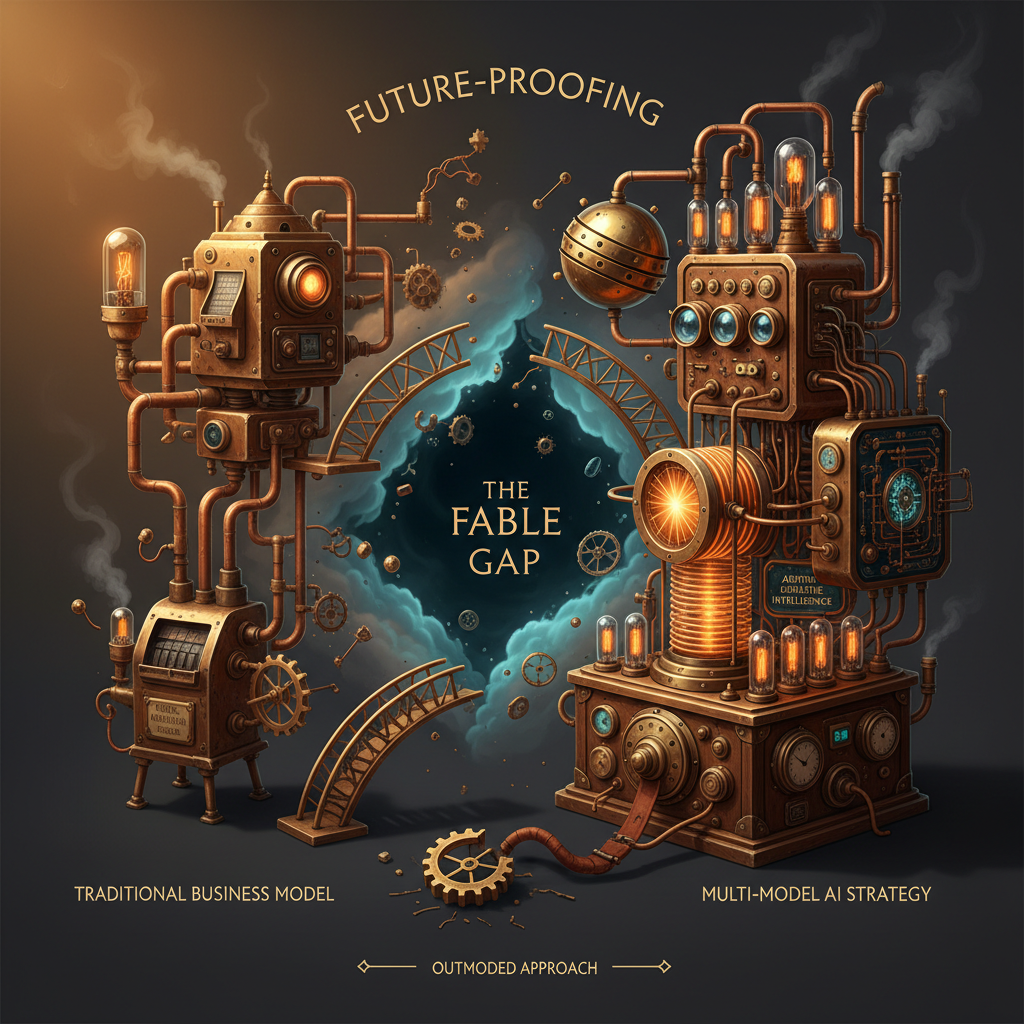
The sudden, hypothetical shutdown of a major AI model provider called 'Fable' has sent a clear warning to the market about the perils of vendor lock-in. This event is accelerating a crucial shift away from relying on a single, frontier model. In its place, a more sophisticated approach is emerging: using a diverse portfolio of AI models, managed by intelligent 'routers', to achieve a blend of performance, cost-efficiency, and resilience. For businesses, this marks a pivotal moment to rethink their AI architecture.
what happened
The AI industry is scrambling to adapt to the vacuum left by the collapse of 'Fable', a fictional but illustrative major AI model provider. The AI Daily Brief reports this has created a 'Fable Gap', catalysing a rapid evolution in how developers and businesses access and deploy AI.
Instead of simply switching to another single provider, the market is embracing a more resilient and efficient multi-model approach. Key developments include:
- A rush to diversify: There is a growing interest in a wider range of models beyond the usual US-based leaders, including powerful open-source models from international developers.
- New orchestration tools: Products like
Cursor's ComposerandOpenRouter Fusionare gaining prominence. These tools act as intelligent layers that can manage and combine the outputs of multiple different models. - The rise of model routing: The central concept is the 'AI router'. This is a system that automatically directs a user's request to the most appropriate model based on the task's complexity. Simple queries are sent to fast, inexpensive models, while more demanding reasoning tasks are routed to powerful, more costly frontier models.
This shift represents a move from a monolithic to a modular AI strategy. The table below summarises the change in thinking.
| Aspect | Single-Provider Strategy | Multi-Model Routing Strategy |
|---|---|---|
| Vendor Dependency | High risk; single point of failure | Low risk; diversified across vendors |
| Cost Structure | High; paying for peak capability on all tasks | Optimised; matches task cost to complexity |
| Performance | Limited to one model's specific strengths | Can select the best model for any given task |
| Resilience | Brittle; an outage or policy change is catastrophic | Robust; can re-route traffic if one model fails |
| Implementation | Simple architecture | More complex initial setup and management |
why it matters
The 'Fable Gap' is a fictional scenario, but it illustrates a very real and growing risk for any business integrating AI. For owners and operators, from small teams to large enterprises, this shift toward multi-model architectures has profound implications.
Risk management is no longer optional
Relying on a single AI provider, no matter how dominant, creates a critical single point of failure. The Fable scenario highlights a few of these risks:
- Provider Failure: A company could shut down, as Fable did.
- API Changes: A provider could deprecate a model or change its API, breaking your workflows.
- Pricing Shocks: A provider could increase prices unexpectedly, wrecking your budget.
- Regulatory & Access Issues: A provider could be forced to restrict access in certain regions or for specific use cases.
A multi-model strategy, where your system can fall back or re-route to another provider, is a fundamental form of business continuity planning in the age of AI.
Unlock significant cost savings
Many businesses are overpaying for AI by using a top-tier model like GPT-4o or Claude 3 Opus for every single task. This is like using a sledgehammer to crack a nut. An enormous percentage of typical business tasks—such as classification, data extraction, or simple summarisation—can be handled perfectly well by smaller, faster, and dramatically cheaper models.
A router-based system automates this decision, ensuring you only pay for premium performance when you truly need it. This can lead to cost reductions of 50-80% or more on your model usage, a critical factor as you scale your AI-powered operations.
Build smarter, more capable agents
No single AI model is the best at everything. One might excel at creative writing, another at logical reasoning, and a third at writing code. By moving beyond a single model, you can design more sophisticated agentic workflows that leverage the unique strengths of different models for different sub-tasks.
This is the next level of AI integration: moving from being a simple consumer of a single AI product to being an orchestrator of a diverse AI toolkit. This is how organisations will build a durable competitive advantage.
what to do next
Waiting for a real-life 'Fable' event to force your hand is not a strategy. Businesses should be proactive in building resilience and efficiency into their AI stack. Here are the practical next steps.
-
Audit Your AI Dependencies: Map out every process in your organisation that relies on an external AI model. Identify which models are being used and, most importantly, where you have a dependency on a single provider. Quantify the volume and cost.
-
Categorise Your AI Workloads: Analyse the tasks you are sending to these models. Group them into tiers based on complexity. For example: Tier 1 (Simple): formatting, classification, extraction. Tier 2 (Medium): summarisation, standard Q&A. Tier 3 (Complex): deep analysis, logical reasoning, novel content creation.
-
Investigate Router Technology: Task your technical team or IT partner with evaluating model routing services. Platforms like OpenRouter are a good place to start, but many major cloud providers and specialised AI platforms are also building these capabilities. The goal is to understand the options for implementing a routing layer.
-
Run a Pilot Project: Select a single, high-volume, low-risk workflow from your audit. Re-implement it using a router with at least two models: a powerful, expensive one and a fast, cheap one. Set the router to direct tasks based on your Tier 1/2/3 categorisation. Measure the cost and performance against the old, single-model baseline. The results will likely make a compelling business case for wider adoption.
-
Formalise a Multi-Model Policy: Update your organisation's technology and procurement policies to treat AI model diversity as a priority. For all new AI projects, require a justification for not using a multi-model, router-based architecture. This embeds resilience and cost management into your organisation's DNA.
sources
From the AI Daily Brief podcast: The Models Trying to Fill the Fable Gap
Original episode: https://podcasters.spotify.com/pod/show/nlw/episodes/The-Models-Trying-to-Fill-the-Fable-Gap-e3kvr3b