

in short
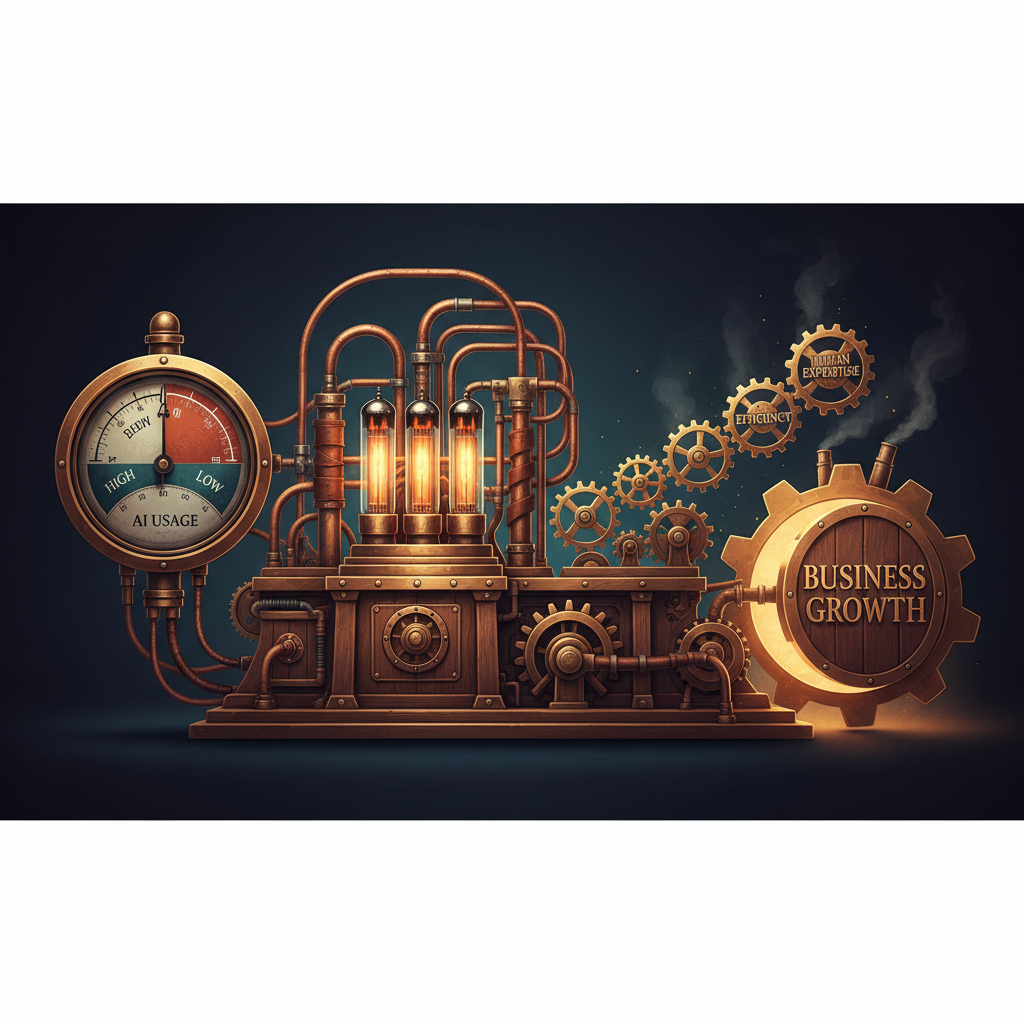
A recent chart sparking fears of an 'AI bubble' is being misread, according to the AI Daily Brief. The data doesn't point to a collapse in demand, but rather a shift in how businesses are using AI. Companies are becoming more efficient, moving from a period of subsidised, high-volume usage to a more strategic approach that optimises for cost and performance. This marks a maturation of the market, not a downturn.
what happened
A chart from a Wall Street analyst recently went viral, suggesting a significant drop-off in activity on some major AI platforms. This has fuelled speculation that the AI boom might be slowing down, or that we are entering an 'AI winter'.
However, the AI Daily Brief podcast presents a compelling counter-argument: this isn't a sign of collapsing demand, but of increasing sophistication among AI users.
From the subsidy era to the scarcity era
The host argues that the market is transitioning between two distinct phases of AI adoption:
-
The Token Subsidy Era: This initial phase was characterised by widespread experimentation, often fueled by free credits, low introductory pricing, and a general lack of cost-consciousness. The goal was to explore possibilities, leading to high-volume, often inefficient usage. Many businesses used the most powerful, expensive models for every single task, regardless of complexity.
-
The Token Scarcity Era: We are now entering a phase where AI usage is a metered, tangible operational cost. Tokens are no longer an abstract concept but a line item on an invoice. Consequently, businesses are becoming rational economic actors, actively seeking to optimise their spend and drive proveable return on investment.
This shift from brute-force experimentation to calculated efficiency is what is being reflected in the data. Businesses are not using AI less, they are using it smarter.
| Characteristic | Token Subsidy Era (The Past) | Token Scarcity Era (The Present) |
|---|---|---|
| Primary Goal | Exploration, discovery | Efficiency, ROI |
| Cost Approach | Ignored or subsidised | Actively managed and optimised |
| Model Strategy | Use the most powerful model for everything | Route tasks to the most cost-effective model |
| Business Focus | "What can we do?" | "What should we do?" |
This perspective is supported by long-term investment trends, such as Goldman Sachs' forecast that AI infrastructure spending will reach a trillion dollars, indicating that serious capital is still flowing into the foundational layers of the ecosystem.
why it matters
For business owners and operators, this shift from a 'growth-at-all-costs' mindset to an 'efficiency-first' approach is significant. It signals a maturing market where real business value, not hype, determines success. The implications for adopting agentic AI are profound.
Efficiency is the new metric for success
In the early days, the headline metric was raw usage. Now, the key performance indicator is efficiency. It's no longer about how many API calls you can make, but how much value you can extract from every dollar spent on AI. This moves the conversation from the IT department's experimentation budget to the core of operational strategy. An AI-powered workflow is now judged not just on its output, but on its cost-effectiveness compared to alternatives.
Cost management becomes a core competency
Simply connecting your application to the latest flagship model from OpenAI or Anthropic is no longer a viable long-term strategy. Businesses must now develop competencies in AI cost management. This involves understanding the pricing differences between models, the performance trade-offs, and the tools available to monitor and control spending. Treating AI like any other utility—such as electricity or cloud computing—is essential.
The rise of the agentic 'router' or 'cascade'
The most practical manifestation of this trend is the adoption of model routing or cascading workflows. Instead of sending every request to a single, expensive model like GPT-4o, a smart system first analyses the task.
- Simple tasks (e.g., summarising a short email, categorising a customer query) are routed to smaller, faster, and cheaper models (like
Haiku,Llama 3 8B, orGemma). - Complex tasks (e.g., writing a detailed legal analysis, generating complex code) are escalated to the more powerful, expensive models.
This tiered approach, managed by an orchestrating 'router' agent, allows a business to dramatically reduce costs while maintaining high quality for the tasks that truly require it. Building this kind of intelligent workflow is a hallmark of sophisticated agentic AI adoption.
This shift creates a sustainable competitive advantage. Companies that master efficient AI usage will build better, cheaper, and faster products and services than those who continue to brute-force their workflows with expensive models.
what to do next
As the market matures, your approach to AI must mature with it. Here are the practical next steps for any business looking to build a sustainable advantage with agentic AI:
-
Audit Your Current AI Spend. Treat your AI usage as a critical business expense. Analyse your invoices from providers like OpenAI, Anthropic, and Google. Identify which applications or workflows are responsible for the highest costs. If you are not yet using AI, start by modelling the potential costs of your intended use cases.
-
Explore a Tiered Model Strategy. Do not default to the most powerful model. Instruct your development team or technical partner to research and implement a 'model cascade'. Start with a cheap, fast model and only escalate to a more expensive one if the initial result is insufficient. This single change can cut costs by 50-90% for many common workflows.
-
Implement Observability and Monitoring. You cannot optimise what you cannot measure. Use tools like LangSmith, Helicone, or other observability platforms to get a granular view of your AI requests. Track costs per-user or per-workflow, monitor latency, and identify which tasks are best suited for which models.
-
Redesign Workflows for Efficiency. Move beyond simple, one-shot AI prompts. Design multi-step agentic workflows that break complex problems into smaller sub-tasks. This allows you to assign each sub-task to the most appropriate (and cost-effective) model, drastically improving overall efficiency.
-
Train Your Team on Cost-Aware AI Use. If your team uses AI tools internally, educate them on the relative costs and capabilities of different models. Create simple guidelines: use the 'smartest' model for creative first drafts and complex reasoning, but use the 'faster' model for editing, summarising, and formatting. This empowers your staff to become part of the solution.
Based on 'The AI Chart Everyone Is Getting Wrong' from The AI Daily Brief.
Original episode: https://podcasters.spotify.com/pod/show/nlw/episodes/The-AI-Chart-Everyone-Is-Getting-Wrong-e3kn910