
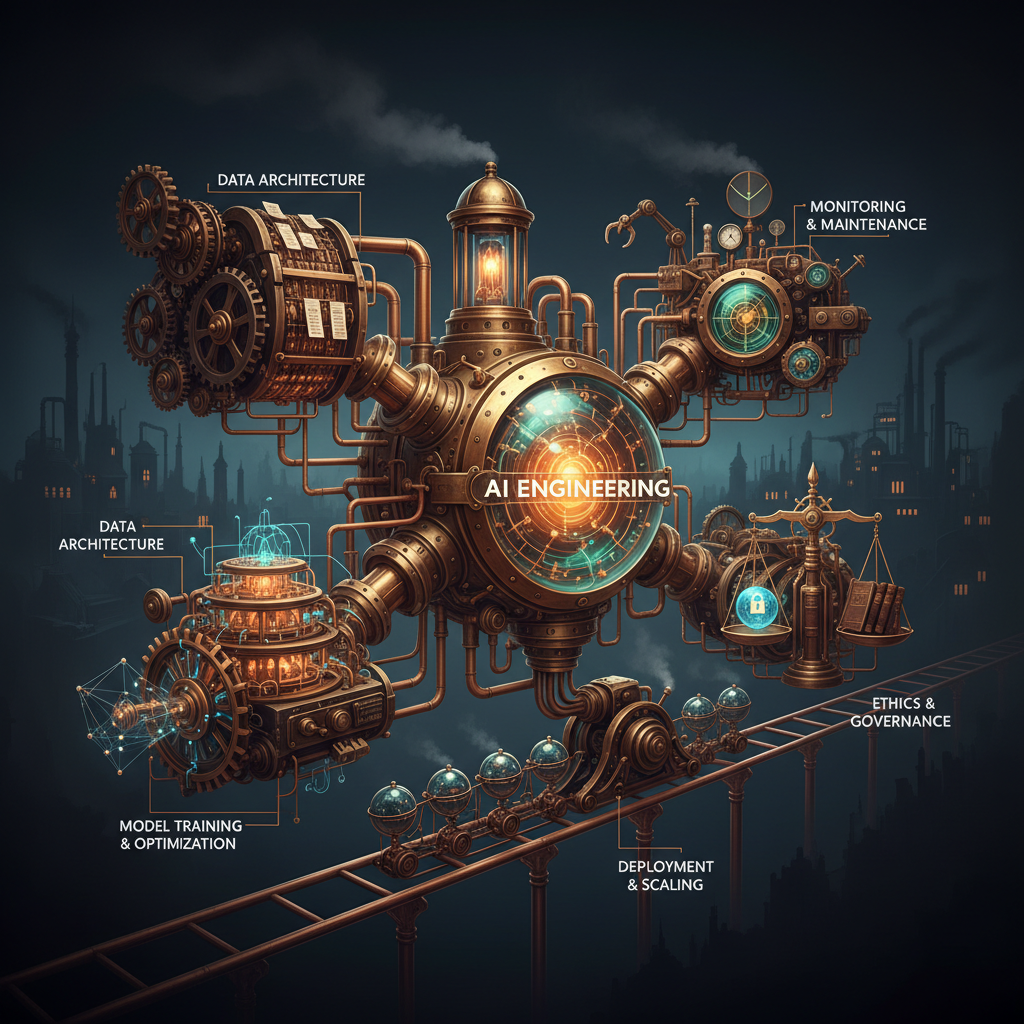

in short
The AI Daily Brief highlights a shift in the skills needed for knowledge work in the age of AI agents. It's no longer just about prompting; a form of 'AI engineering' is now essential for every knowledge worker. This involves designing agentic workflows, building simple tools, identifying new opportunities, and critically evaluating AI outputs with deep domain expertise.
what happened
The latest AI Daily Brief podcast discusses the evolution of skills required for knowledge workers, proposing that a new discipline of 'AI engineering' is becoming essential for non-technical staff.
As artificial intelligence matures from simple, one-shot tools like ChatGPT into multi-step, autonomous agents, the ability to merely write a good prompt is no longer sufficient. To truly leverage these advanced systems, employees need a more structured set of skills that combine technical understanding, process thinking, and business acumen.
This new 'AI engineering' skillset for knowledge workers isn't about writing Python code; it's about effectively orchestrating AI to perform complex business functions. We can break this down into a five-part framework that organisations can use to guide their upskilling efforts.
The five core AI engineering skills
| Skill | Description | Business Example |
|---|---|---|
| 1. Agentic Workflow Design | Deconstructing complex business processes into sequential, logical steps that can be assigned to AI agents. | Mapping out an automated customer onboarding process, where agents handle data entry, welcome emails, and CRM updates. |
| 2. Prompt Engineering & Model Steering | Iteratively crafting and refining instructions to guide AI models, understanding their limitations and biases to achieve specific, high-quality outcomes. | A marketing manager refining a prompt over several iterations to generate a series of social media posts that match the company's brand voice. |
| 3. Low-Code Tool Building | Using platforms like Zapier or Make to connect different apps and AI models, creating simple custom automations without writing extensive code. | An HR coordinator building a tool that automatically parses resumes from an inbox, uses an AI to summarise them, and adds the summary to a spreadsheet. |
| 4. Opportunity Recognition | Applying systems thinking to identify business challenges or market gaps that can now be solved with agentic AI, moving beyond simple task automation. | A logistics manager realising they can use AI agents to constantly monitor shipping routes, weather, and traffic data to proactively re-route shipments. |
| 5. Critical Evaluation & Domain Judgment | Applying human expertise to validate, correct, and contextualise AI-generated outputs, ensuring accuracy, quality, and alignment with business goals. The final human checkpoint. | A financial analyst using an AI to draft a market report but then manually verifying all key figures and adding their own expert interpretation of the trends. |
why it matters
The transition from basic AI usage to AI engineering is not just a semantic shift; it has direct implications for productivity, competitive advantage, and risk management.
Productivity and workflow redesign
Basic AI prompting helps individuals complete discrete tasks faster. Agentic AI engineering, however, allows teams to redesign entire business workflows. The productivity gain isn't just about saving an employee an hour on writing a report. It's about automating the entire 20-step process of data collection, analysis, drafting, and distribution that the report is a part of. Businesses that master this will unlock compounding efficiencies that others cannot match.
Democratising innovation and agility
Historically, creating automated solutions required significant investment and the time of scarce developer resources. The rise of low-code platforms combined with AI engineering skills means employees closest to a problem can now build their own solutions. An operations manager can design an agent to automate inventory checks without needing to join a six-month IT queue. This democratisation dramatically increases an organisation's agility and problem-solving capacity.
Moving from user to creator
Companies that only teach their staff basic prompting will remain passive users of off-the-shelf AI products. In contrast, organisations that cultivate these five engineering skills empower their teams to become creators of bespoke, high-value AI systems. This is the difference between renting a tool and owning the factory. The ability to build custom agents tailored to your unique processes and data is a significant and defensible competitive advantage.
Proactive risk management
As AI agents are given more autonomy, the potential for costly errors grows exponentially. An AI making a mistake in a single email is one thing; an agent making a mistake in 10,000 automated customer interactions is a crisis.
The skill of Critical Evaluation & Domain Judgment is the most important risk mitigation tool your business has. It ensures that human oversight is embedded into automated processes, safeguarding against financial, reputational, and legal damage.
what to do next
For business owners and operators, the path forward involves a deliberate strategy to cultivate these AI engineering skills within your teams. Here are five practical steps to get started:
-
Audit your team's current skills and AI usage. Look beyond who has a
ChatGPT Plussubscription. Identify the individuals who are already trying to connect different tools or automate multi-step tasks. These are your proto-AI engineers, and they can become champions for a broader program. -
Invest in targeted, project-based training. Generic 'Intro to AI' courses are not enough. Seek out training that focuses specifically on workflow design, systems thinking, and hands-on experience with low-code automation platforms. The goal is for your team to build something, not just listen to a lecture.
-
Establish a 'sandbox' for experimentation. Provide your team with approved access to tools like
Zapier,Make, or a corporateOpenAIaccount with a set budget. Encourage them to build small-scale agents for non-critical, internal tasks. This creates a safe environment to learn, fail, and innovate without risking core business operations. -
Formalise the 'human-in-the-loop'. As you deploy AI agents into more workflows, explicitly define the roles and responsibilities for human oversight. Update job descriptions to include 'Critical Evaluation of AI outputs' as a key responsibility. This builds accountability and reinforces the importance of domain expertise.
-
Start small, document, and scale. Choose a single, well-understood business process that is repetitive and rule-based. Task a small, cross-functional team to redesign it using an agentic workflow. Have them document the entire process: the 'before' and 'after' state, the tools used, the time and cost savings, and any challenges they faced. This first project becomes your internal case study and a blueprint for scaling AI engineering across the organisation.
Based on 'The AI Engineering Skills Map for Knowledge Workers' from The AI Daily Brief.
Original episode: https://podcasters.spotify.com/pod/show/nlw/episodes/The-AI-Engineering-Skills-Map-for-Knowledge-Workers-e3nj56h