

in short
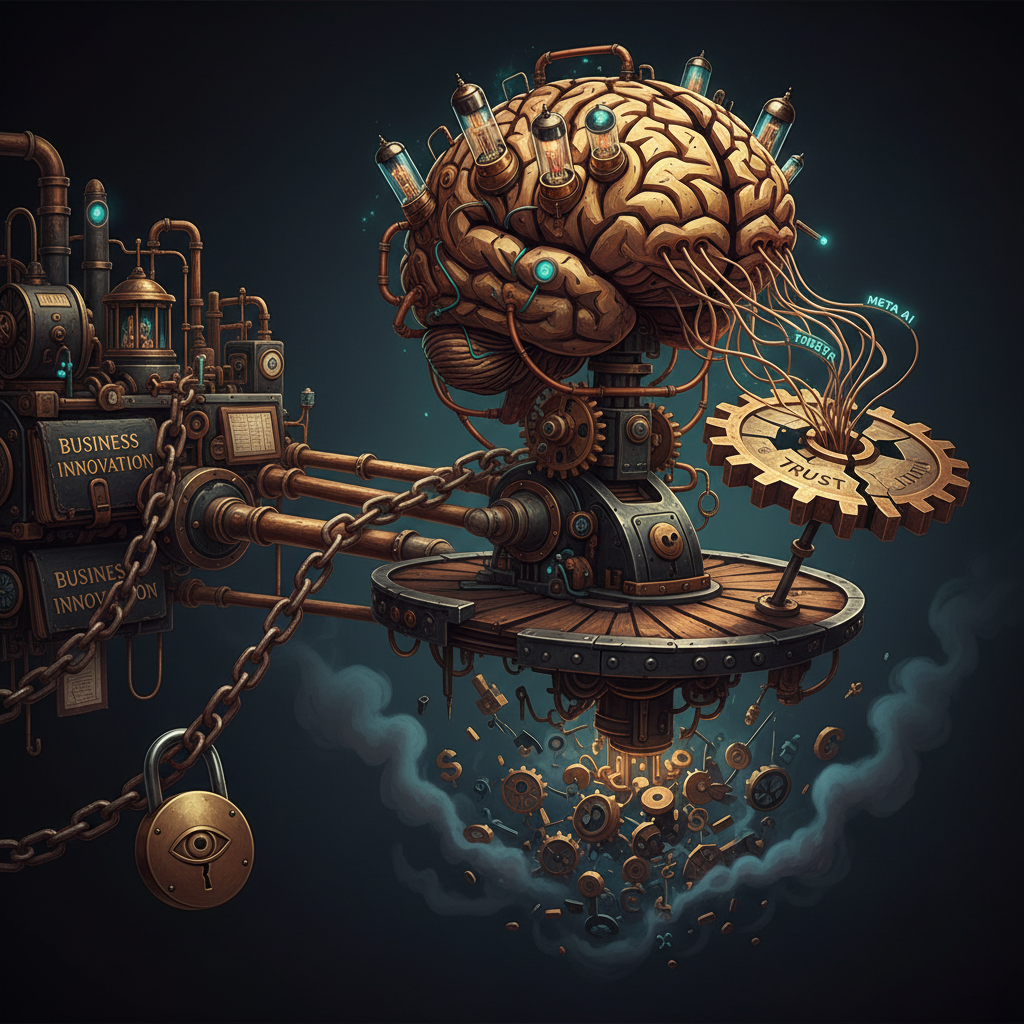
Meta's Mark Zuckerberg is promoting an optimistic vision for an AI-powered future, backed by a new open source model and a $1 billion community fund. The goal is to position Meta as the leader of an accessible, empowering AI movement. However, as the AI Daily Brief notes, the company's significant trust deficit complicates this push, turning a technical decision for businesses—which AI platform to use—into a complex strategic and reputational one.
what happened
Meta has launched a significant campaign to shape the public narrative around artificial intelligence, positioning itself as the leader of an open and optimistic movement.
As detailed in the AI Daily Brief, CEO Mark Zuckerberg has articulated a vision for AI that emphasises:
- Personal empowerment: Giving individuals and smaller organisations access to powerful tools.
- Open models: Releasing the underlying code of its AI models (like the
Llamaseries) for broad use and modification, in contrast to the closed, proprietary models from competitors like OpenAI and Anthropic. - Economic opportunity: Fostering new jobs and industries around an open ecosystem.
To support this, Meta has announced a new open model and a $1 billion community fund to encourage development on its platform. This move frames the AI landscape as a choice between two distinct philosophies.
| Feature | Open Source (Meta's approach) | Closed Source (e.g., OpenAI, Anthropic) |
|---|---|---|
| Access | Model weights are public; can be self-hosted. | Access via API; vendor-hosted. |
| Cost | Primarily infrastructure and implementation costs. | Pay-per-use (token-based). |
| Customisation | High. Can be fine-tuned extensively for specific tasks. | Limited to what the API allows. |
| Control | Full control over the model and its deployment. | Dependent on vendor for updates, uptime, and terms. |
| Transparency | High. Researchers can inspect the model architecture. | Low. The inner workings are a 'black box'. |
The core challenge identified by the podcast is that this optimistic, open vision is being championed by one of tech's least trusted figures. This creates a disconnect between the technical promise of open source AI and the public's perception of its primary backer.
why it matters
For business owners and operators, Meta's push into open source AI is more than just another technology release; it introduces a new layer of strategic risk to your AI adoption plans.
The choice of AI model is now a brand decision
Choosing between an open model like Meta's Llama and a closed one like OpenAI's GPT-4 is no longer a purely technical or financial decision. It's now a question of brand alignment and reputational risk. Building your next generation of products or internal agentic workflows on a Meta-backed platform means your organisation's reputation becomes implicitly linked to Meta's.
If Meta faces another major privacy scandal or public backlash, your business could experience reputational contagion. Customers and partners may question the ethics and safety of your AI-powered services simply because of the technology's origin.
The open source cost-benefit analysis has changed
Traditionally, the trade-off for open source software has been lower direct costs and greater flexibility in exchange for higher internal support and security burdens. Now, you must add 'reputational risk' to the 'cons' column.
- Pro: Avoiding vendor lock-in with a closed provider remains a powerful incentive. Open models give you control over your technology stack and protect you from sudden price hikes or API changes.
- Con: You are responsible for everything. With a closed model, the provider takes on much of the reputational heat for model failures or biases. With an open model that you self-host and fine-tune, that responsibility shifts almost entirely to you. When combined with a controversial primary sponsor, the risk is magnified.
Impact on agentic workflows
For businesses developing AI agents to automate complex workflows, open source models offer the tantalising promise of deep customisation. You can fine-tune an agent's behaviour, skills, and knowledge base in ways that are impossible with a closed API. However, this deep integration also means you are embedding the model's inherent characteristics—including any flaws, biases, or security vulnerabilities—directly into your core business processes. A problem in the foundational model becomes a problem in your organisation's operational centre.
what to do next
The strategic landscape for AI is becoming more complex. Businesses need to move beyond simple performance benchmarks and adopt a more holistic evaluation process for their AI strategy.
-
Update your evaluation criteria. When choosing a foundational model, expand your checklist beyond performance and price. Add these factors to your assessment:
- Provider Reputation: What is the public perception of the model's primary developer or sponsor?
- Ecosystem Health: Is there a diverse and independent community building around the model, or is it solely dependent on its corporate sponsor?
- Risk of Contagion: What is our exposure if the platform provider faces a major public crisis?
- Support and Indemnity: What level of support is available? Does the provider offer any legal or security indemnity (often a benefit of paid, closed models)?
-
Conduct a formal risk assessment. Treat your AI model choice like any other critical supply chain decision. Map out the potential failure points, including technical, financial, and reputational risks. Develop a contingency plan: what happens if your chosen open source model is abandoned or your closed API provider dramatically changes its terms?
-
Consider a diversified model strategy. Avoid going 'all-in' on a single provider or philosophy. Use different models for different tasks based on risk profiles. For example:
- Use a trusted, closed API model for sensitive, customer-facing applications.
- Experiment with open source models for internal, low-risk agentic workflows where you can control the environment and closely monitor performance and safety.
-
Stay informed on the governance debate. The tension between open and closed AI is becoming a central political and regulatory issue. Monitor developments in AI governance and legislation, as these may favour one model over the other, impacting your long-term strategy.
From the AI Daily Brief: AI Optimism Has a Trust Problem
Original episode: https://podcasters.spotify.com/pod/show/nlw/episodes/AI-Optimism-Has-a-Trust-Problem-e3n9egg